Designing operational intelligence around the Delta metric
How a single analytical abstraction transformed fragmented RFQ pricing data into a more meaningful procurement intelligence workflow.
Most procurement dashboards focus on visualization: carrier pricing, shipment volumes, RFQ participation, or lane-level reporting. The challenge was not the lack of data , it was the lack of operational reasoning across that data.
RFQ workflows generated fragmented pricing signals across carriers, regions, and shipment modes, but traditional dashboards struggled to explain where procurement opportunities actually existed.
The goal was not simply building another reporting layer. It was designing a system capable of identifying commercially meaningful pricing deviations inside operational RFQ workflows.
The Delta column became the operational intelligence layer
The most important engineering decision was not the dashboard, the model, or the SQL pipeline. It was introducing a Delta metric capable of comparing procurement pricing behavior against operational baselines.
Standard RFQ columns showed historical pricing information. The Delta layer introduced comparative operational meaning.
| Column Type | Example | Purpose |
|---|---|---|
| Standard Column | Carrier Rate | Raw RFQ pricing visibility |
| Standard Column | Lane Volume | Shipment activity tracking |
| Custom Intelligence Layer | Delta Metric | Identified procurement pricing deviations and commercial opportunity zones |
That distinction mattered because the Delta layer transformed the system from passive reporting into operational intelligence.
AI-native procurement architecture
The architecture combined lightweight analytics infrastructure, local LLM workflows, and operational query orchestration into a unified intelligence pipeline.
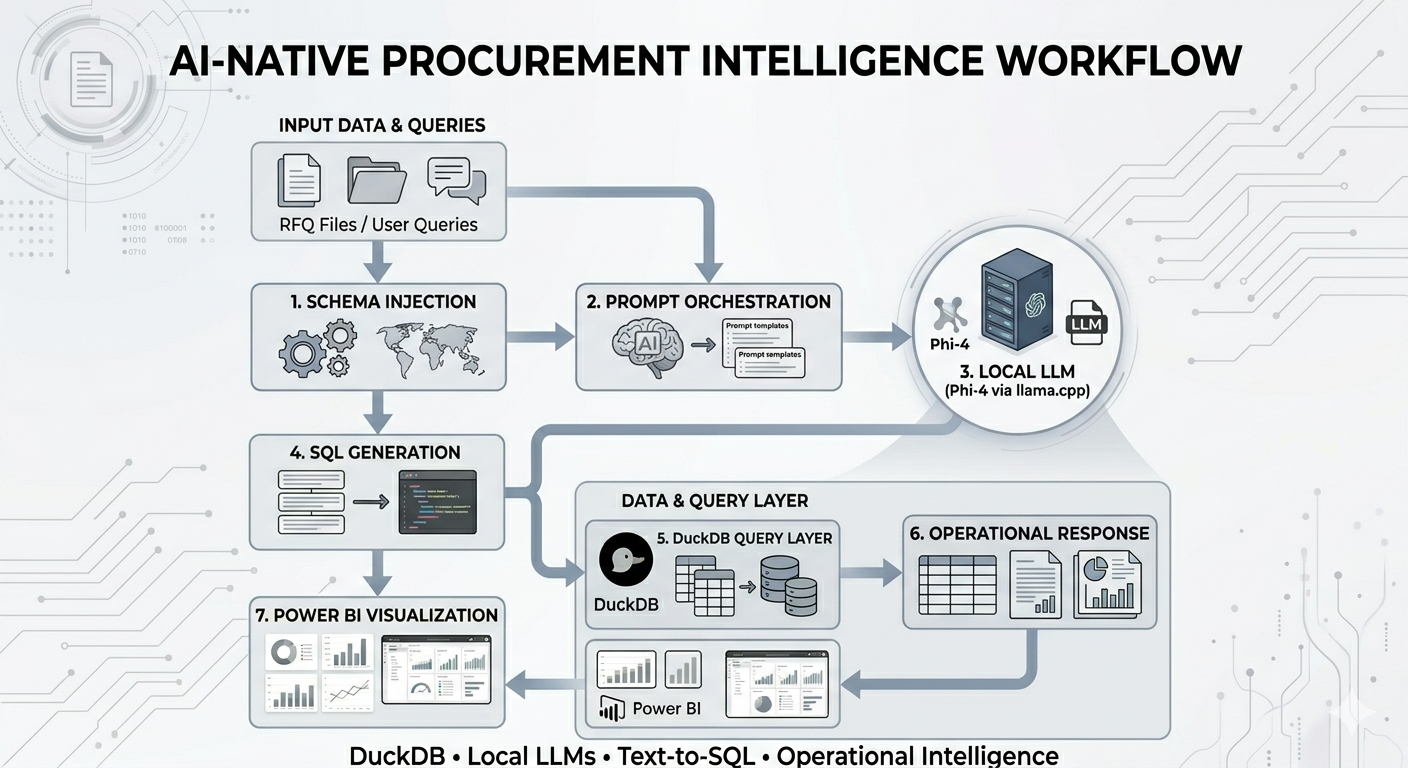
The text-to-SQL orchestration pipeline
Schema Injection
Operational table structures and procurement metadata were injected into the prompt context.
Prompt Orchestration
The system constrained model behavior toward deterministic analytical reasoning.
SQL Generation
The local LLM generated structured DuckDB-compatible analytical queries.
DuckDB Execution
Queries were executed directly against lightweight operational datasets.
Operational Interpretation
Results were surfaced through dashboards and intelligence workflows.
Breaking the workflow into distinct orchestration stages mattered. It demonstrated that the system was not “a chatbot attached to BI,” but an operational reasoning pipeline designed around structured procurement workflows.
The real innovation was not the technology
The most important realization from the project was that the intelligence layer did not come from the model itself.
The real innovation came from identifying the operational abstraction that mattered , the Delta metric , and designing the surrounding architecture to reason around it effectively.
The technology stack enabled the workflow, but the commercial value emerged from understanding procurement behavior deeply enough to define the right intelligence layer in the first place.